






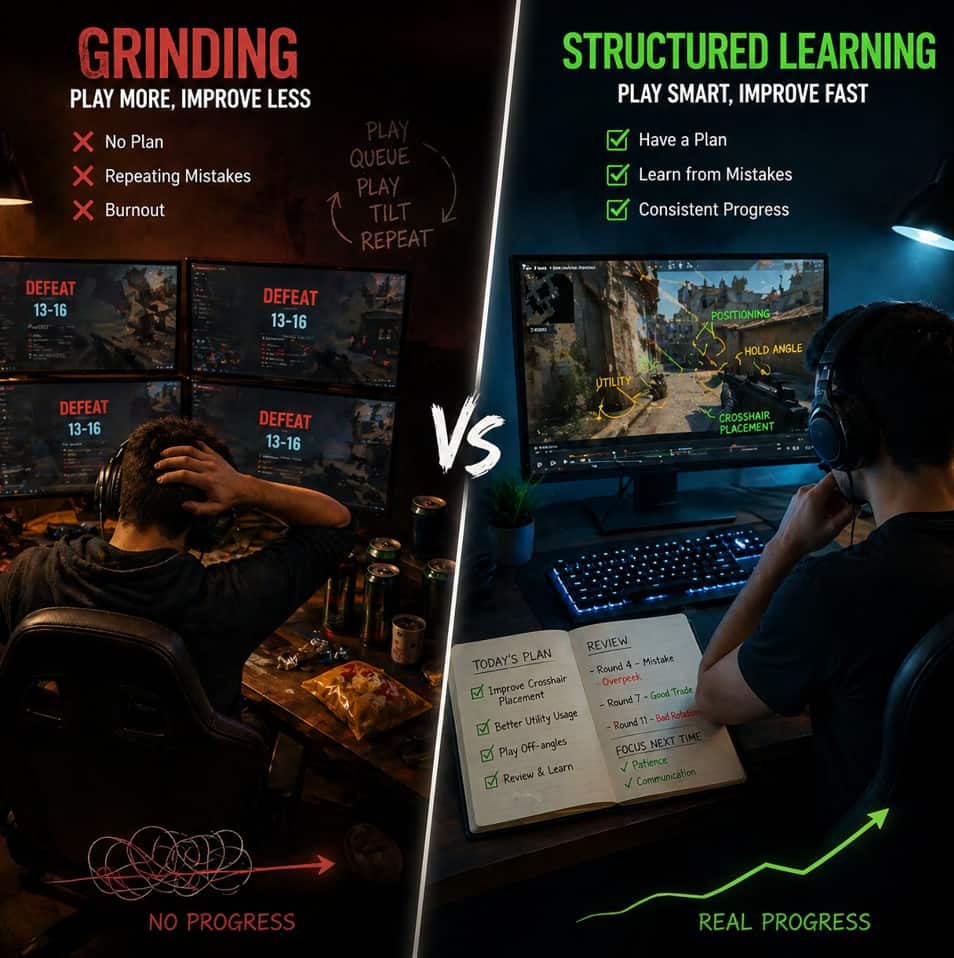
The Problem with Grinding
Grinding is the default approach for most players. You log in, play several matches in a row, and hope your performance improves naturally over time. While experience does matter, grinding alone has clear limitations.
When you play without a plan, it’s easy to fall into autopilot. You react rather than think, and mistakes repeat without being noticed. Over time, this creates a cycle where you gain experience but not necessarily skill. You might have hundreds of matches played, yet still struggle with the same positioning errors or poor decisions.
Typical issues that come from pure grinding include:
- Repeating the same mistakes without awareness
- Focusing only on wins and losses instead of performance
- Playing on autopilot instead of improving with intention
Grinding feels productive because you’re putting in time, but without reflection, that time is not used effectively.
What Is Structured Learning?
Structured learning takes a more deliberate approach. Instead of relying solely on repetition, it focuses on targeted improvement. Each session has a purpose, and every mistake is an opportunity to learn.
In simple terms, structured learning involves:
- Identifying specific weaknesses
- Practicing targeted skills
- Reviewing your performance regularly
- Tracking progress over time
This is the same approach used in education and sports training. Instead of trying to improve everything at once, you break your development into smaller, manageable parts.
Why Structured Learning Works Better
The biggest advantage of structured learning is efficiency. You spend less time repeating mistakes and more time fixing them. Instead of hoping your aim improves through random matches, you actively work on crosshair placement, positioning, or decision-making.
For example, a player who grinds might play five matches in a row, hoping for better results. A player using structured learning might play fewer games but spend time reviewing key moments, understanding mistakes, and applying adjustments in the next session.
This leads to faster and more consistent improvement because you are actively correcting issues rather than reinforcing them.
Breaking Down Your Gameplay
One reason structured learning is effective is that it treats CS2 as a set of individual skills rather than one overall ability. When everything is grouped together, it becomes difficult to know what to improve.
By separating your gameplay into key areas, improvement becomes clearer and more manageable. These areas often include aim, positioning, decision-making, utility usage, and communication. Instead of trying to fix everything at once, you focus on one or two areas at a time. This reduces overwhelm and allows you to see measurable progress. Over time, these small improvements combine into a stronger overall performance.
Applying Structured Learning to FACEIT
You don’t need a complex system to start. Structured learning can begin with a simple habit of reviewing your matches and identifying patterns. The goal is to move from random play to intentional practice.
Start by asking yourself what is consistently going wrong. Are you dying early in rounds? Are you losing duels you should win? Once you identify a pattern, turn it into a goal for your next session.
For example, if you often die early, your focus might be to play more safely during the opening seconds of each round. During your matches, stay aware of that goal. Afterward, review whether you improved or repeated the same mistake. This cycle of practice and reflection is what drives real progress.
Using Tools to Support Learning
While structured learning can be done manually, tools can make the process easier. Demo reviews let you revisit situations and understand mistakes that weren’t obvious in real time. Analytics tools can highlight trends in your gameplay, such as low survival rates or inconsistent performance.
These tools provide clarity. Instead of guessing what went wrong, you can see it directly. Over time, this makes your practice more focused and effective. However, tools are only helpful if you use them with purpose. The goal is not just to collect data but to turn it into actionable insights.
Common Mistakes to Avoid
Even when trying to improve, players can fall into habits that slow their progress. One of the most common mistakes is trying to fix too many things at once. This often leads to confusion and inconsistency.
Another issue is skipping the review. Playing without analyzing your performance limits your ability to learn from mistakes. Improvement comes from understanding why something went wrong, not just experiencing it.
It’s also important to be patient. Structured learning takes time, but the progress is more stable compared to short-term gains from grinding.
The Truth About “Boosting” Your Level
Many players look for ways to boost their FACEIT level quickly. While shortcuts might seem appealing, they don’t lead to lasting improvement. Without the necessary skills, maintaining a higher rank becomes difficult.
Structured learning offers a better alternative. By focusing on real improvement, you not only climb but also develop the ability to stay at that level. The goal is not just to reach a higher rank, but to perform consistently once you get there.
Building a Simple Routine
To make structured learning part of your routine, keep it straightforward. Set a goal before each session, play with that focus in mind, and review at least one match afterward.
A simple cycle might look like this:
- Identify a weakness
- Practice with intention
- Review your performance
- Adjust and repeat
This approach turns every match into a learning opportunity rather than just another game played.
Final Thoughts
Climbing FACEIT levels is not just about playing more. It’s about improving in a focused and consistent way. Grinding without direction can only take you so far, but structured learning gives you a clear path forward.
By breaking down your gameplay, setting specific goals, and learning from your mistakes, you create steady progress. It may require more effort upfront, but the results are more reliable and long-lasting.
In the end, the players who climb are not simply the ones who play the most. They are the ones who understand their game, learn from it, and improve with purpose.

 That is where an SAP preferred partner can make a real difference. Working with a partner that understands both enterprise software and the unique demands of education helps EdTech platforms evolve beyond basic features. Enterprise resource planning and analytics become more than buzzwords. They become practical tools to simplify data flow, empower instructors, and enhance student experiences.
 Education technology, or EdTech, has transformed the way students learn and teachers teach. From virtual classrooms to mobile learning apps, technology now supports nearly every part of education. Students can access lessons anytime, collaborate with classmates online, and explore interactive tools to learn more. For teachers and schools, EdTech helps track progress, personalize lessons, and reach more learners.